Nexeed
    • Introduction
    • User manual
      • General descriptions
        • Result lists
        • Scope Concept
      • Basic setup
        • Connection management
        • Scope Management
          • Configuration Scopes
          • Reporting Scopes
      • Traceability
        • Types of evaluations
        • Search Forms for creating an evaluation
        • Part Protocol
          • Quick Search
          • Extended Search
          • Part View
          • Process View
          • Component View
          • Part Information
          • Process Information
        • Forward Search
          • Quick Search
          • Extended Search
        • Backward Search
        • Tool Usage
        • Packaging Information
          • Quick Search
          • Extended Search
      • Archiving
        • Enable archiving
        • Monitoring
      • Quality Gate
        • Types of Quality Gate Checks
        • Working with Test Specifications
        • Testing of Test Specifications
          • Basic test client
          • Expert test client
          • JSON based test client
      • Terms and definitions
        • Archiving states
        • Connection states
        • Packaging data
        • Part blocks
        • Process data
        • SPC session data
        • Test Specifications
    • Operations manual
      • Overview
      • System architecture and interfaces
        • Data Collector Service
        • Data Browser Service
        • Archiving Bridge Adapter Service
        • Configuration Service
        • Quality Gate Service
        • Reporting Service
        • Quality Database (QDB)
        • Archiving Bridge Adapter Service database
      • System requirements
      • Migration from previous versions
        • Migration from MES QualityData
        • Part Traceability upgrades
      • Setup and configuration
        • Base configuration
        • Quick start configuration
        • Application and service account roles
        • Scope-based configurations
        • Data Collector Service
        • Data Browser Service
        • Archiving Bridge Adapter Service
        • Reporting Service
        • Quality Database (QDB)
        • Module database
        • Archiving Bridge Adapter Service database (QDAB)
        • Resources in Part Traceability
        • Dos and don’ts in databases
      • Start and shutdown
      • Regular operations
      • Failure handling
      • Backup and restore
      • Logging and monitoring
      • Known limitations
    • Developer documentation
      • Deep Dives
        • Forwarding via Data Publisher
        • Resolving of Scopes
      • Quality Gate Checks
        • Structuring of Test Specifications
        • Input and output parameters
          • Check Block List
          • Check Complete (location based)
          • Check Complete (process based)
          • Check Component
          • Bypass Check Complete
          • Check Trace Mapping
          • Check Characteristics
      • Troubleshooting
    • API documentation
      • Data Browser Service
      • Data Collector Service
        • Structure and content of telegrams
          • basicInfo
          • partDetails
          • componentTrace
          • additionalInfo
          • packaging
      • Quality Gate Service
      • Archiving Bridge Adapter Service
    • Glossary
Part Traceability
  • Industrial Application System
  • Core Services
    • Block Management
    • Deviation Processor
    • ID Builder
    • Multitenant Access Control
    • Notification Service
    • Ticket Management
    • Web Portal
  • Shopfloor Management
    • Andon Live
    • Global Production Overview
    • KPI Reporting
    • Operational Routines
    • Shift Book
    • Shopfloor Management Administration
  • Product & Quality
    • Product Setup Management
    • Part Traceability
    • Process Quality
    • Setup Specs
  • Execution
    • Line Control
    • Material Management
    • Order Management
    • Packaging Control
    • Rework Control
  • Intralogistics
    • AGV Control Center
    • Stock Management
    • Transport Management
  • Machine & Equipment
    • Condition Monitoring
    • Device Portal
    • Maintenance Management
    • Tool Management
  • Enterprise & Shopfloor Integration
    • Archiving Bridge
    • Data Publisher
    • Engineering UI
    • ERP Connectivity
    • Gateway
    • Information Router
    • Master Data Management
    • Orchestrator

Nexeed Learning Portal

  • Part Traceability
  • User manual
  • Basic setup
  • Scope Management
  • Configuration Scopes

Configuration Scope management

A Configuration Scope groups a set of configuration elements:

  • Test Specifications (for Quality Gate Checks)

  • Database Connections (OLTP and OLAP)

  • Settings (Archiving, Quality Gate, etc.)

Configuration Scopes are used for all inbound data and production near processes. They are used to resolve the correct configuration during production time. If no scope is configured or no scopeName parameter is provided when sending data to Part Traceability module, the default scope default_config is used. Synonyms for Configuration Scope are: Product Key or Value Stream identifier.
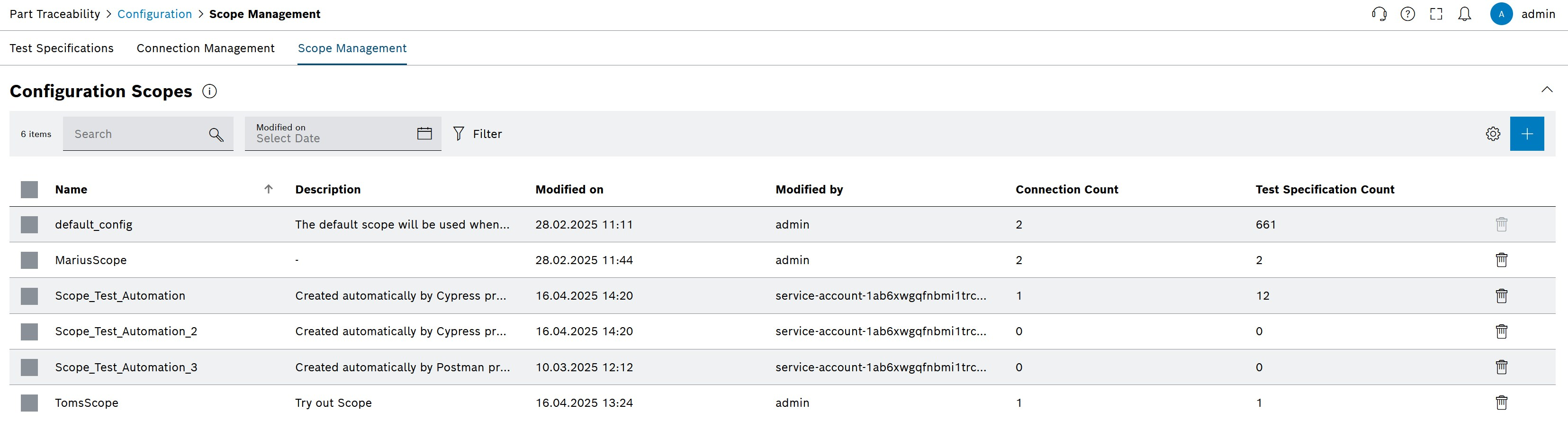
Configuration Scope - Connections
Element / Icon Description

<n> entries

Number of entries in the list.

Search search

Enter the search term to filter the entries.

Modified on

Define Date with calendar.

filter

Use a filter

settings

Add, remove and reorder columns.

filter

Add Configuration Scope

Delete

Delete Configuration Scope

Add Configuration Scope

  1. Open Part Traceability > Configuration menu entry.

  2. Click on the Scope Management tab.

  3. Click on add border in the header.

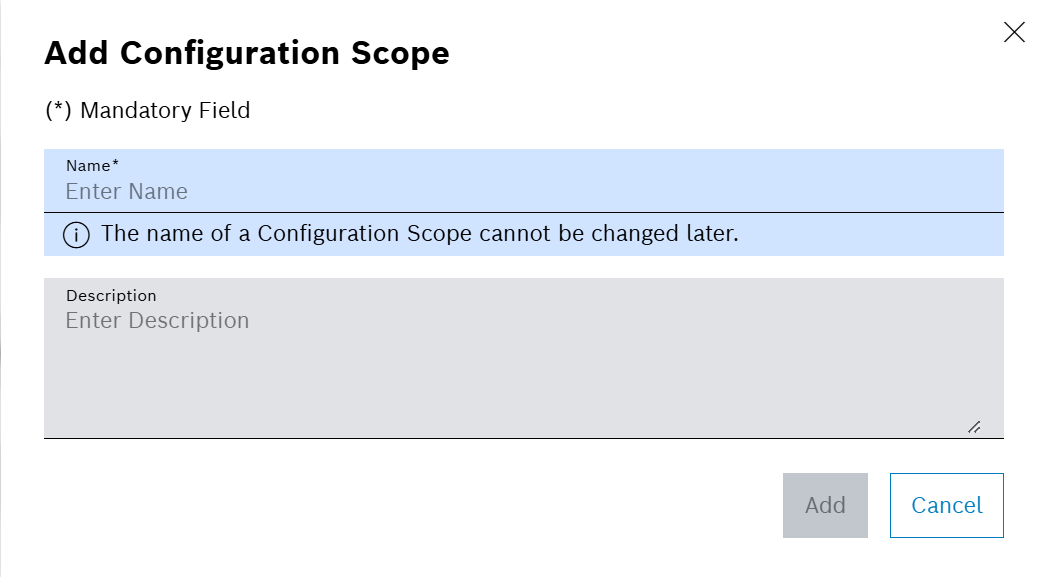
    The dialog window opens.

    Add Configuration Scope
  4. Enter the data in the Add Configuration Scope window.

  5. Click on Add.

    The dialog window is closed and the new scope is shown in the list.

    The Configuration Scope is not yet usable in Part Traceability. All necessary configurations, such as database connections and settings, need to be properly defined and saved before usage.

    Spaces before or after the actual Scope name are not taken into account or saved. Therefore, using the same Scope name with or without spaces is not possible.

Assign connections

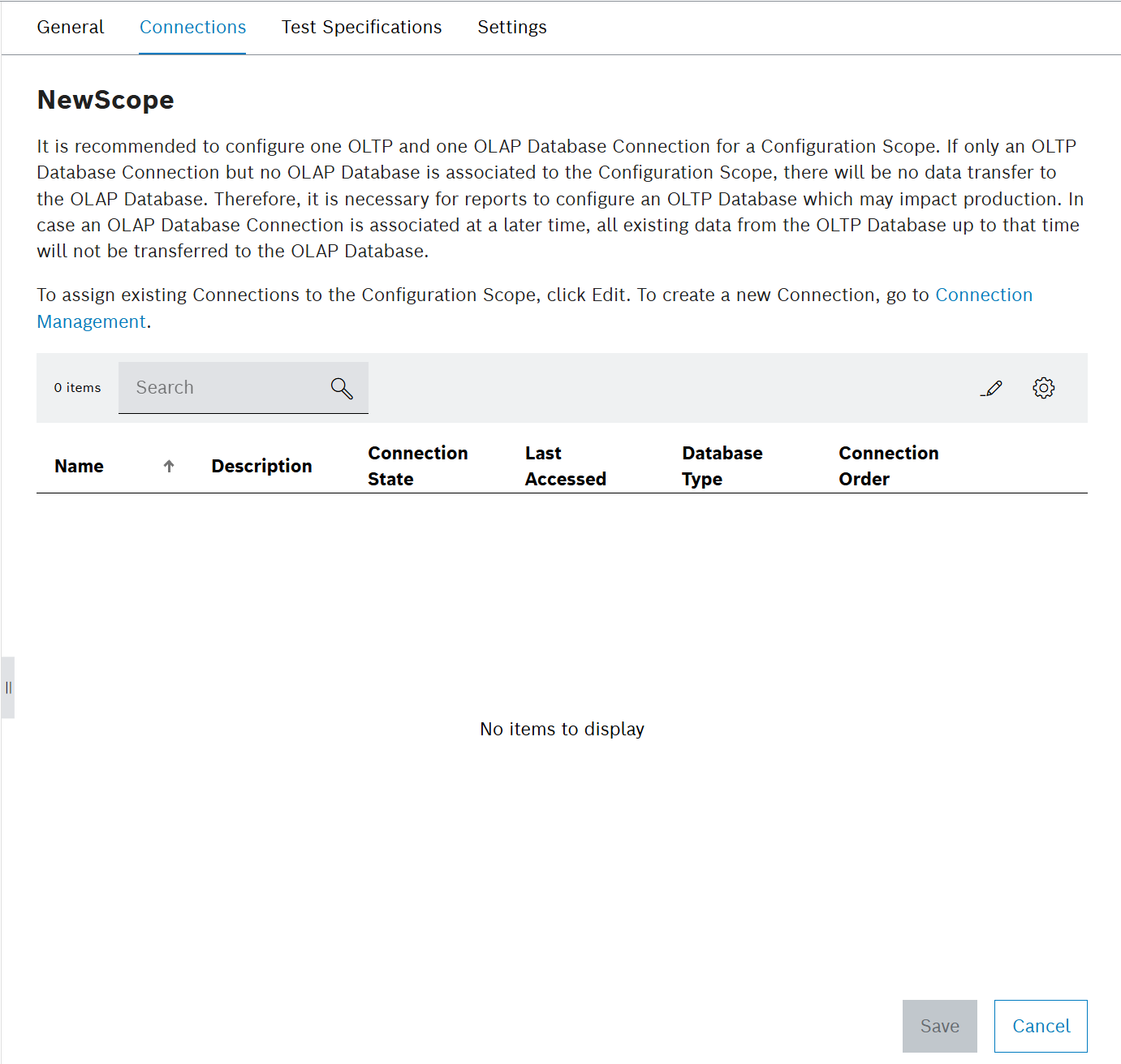
Defines the database connections to be used for the Configuration Scope, thus defining where the incoming data is stored.

It is recommended to configure one OLTP and one OLAP Database Connection for a Configuration Scope.

  • The transfer from OLTP database to OLAP database is only enabled if both connections are configured. If this is not the case, there will be no data transfer (OLTP → OLAP) and in order to create evaluations, it is necessary to configure an OLTP database which may impact production.

  • In case an OLAP Database Connection is assigned at a later time, all existing data from the OLTP database up to that time will not be transferred to the OLAP database.

  • It is not valid to configure only an OLAP Database Connection without an OLTP Database Connection.

  • Only one type of database connection (either OLTP or OLAP) can be configured per Configuration Scope.

  • An OLTP Database Connection can only be assigned to a single Configuration Scope.

Prerequisites

  • Add Database Connection

  • Add Configuration Scope

Procedure

  1. Open Part Traceability > Configuration menu entry.

  2. Click on the Scope Management tab.

  3. Click on the Configuration Scope to be edited.

    A side panel opens. The General tab is shown.

  4. Click on the Connections tab.

    add_connection_to_scope
  5. Click on edit.

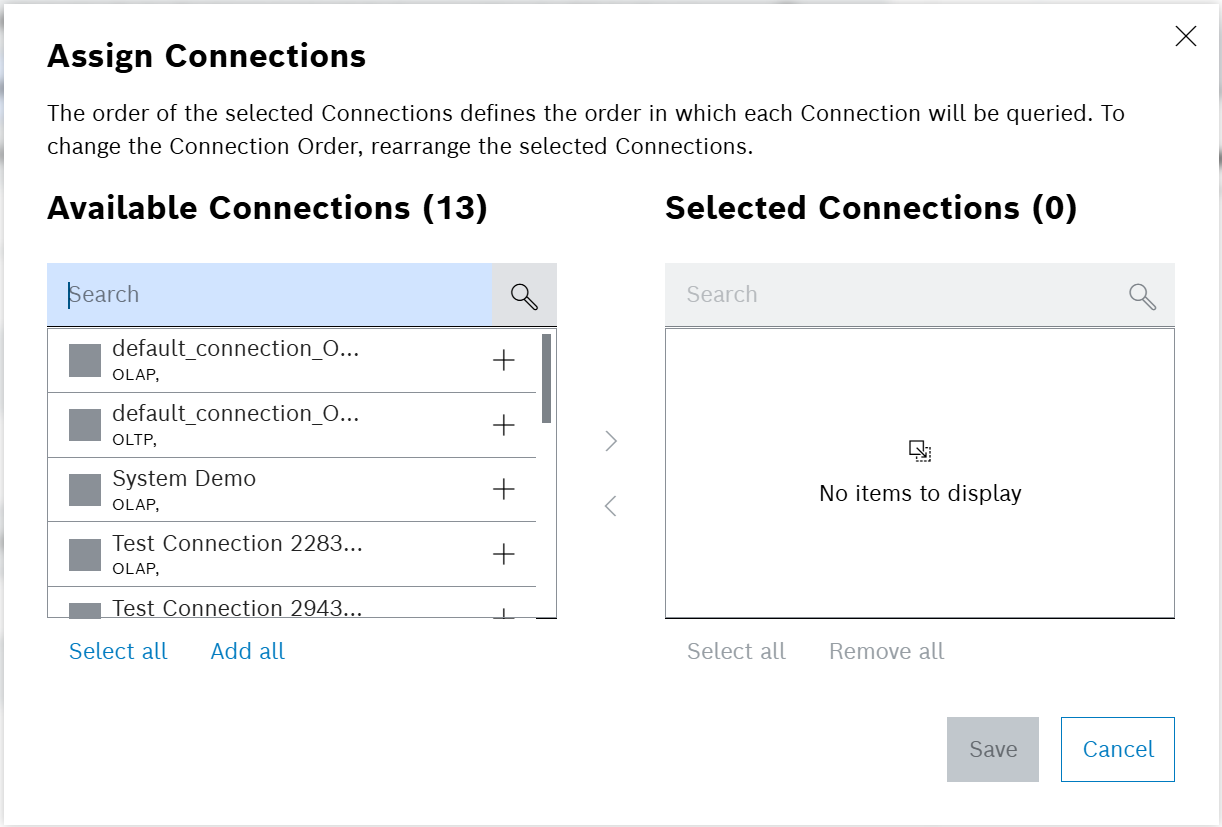
    The dialog window opens.

    Open Assigning Connections
  6. In the Assign Connections window, select the connections to be assigned to the Scope.

  7. To change the order of the selected connections in the list, move the entries using drag and drop.
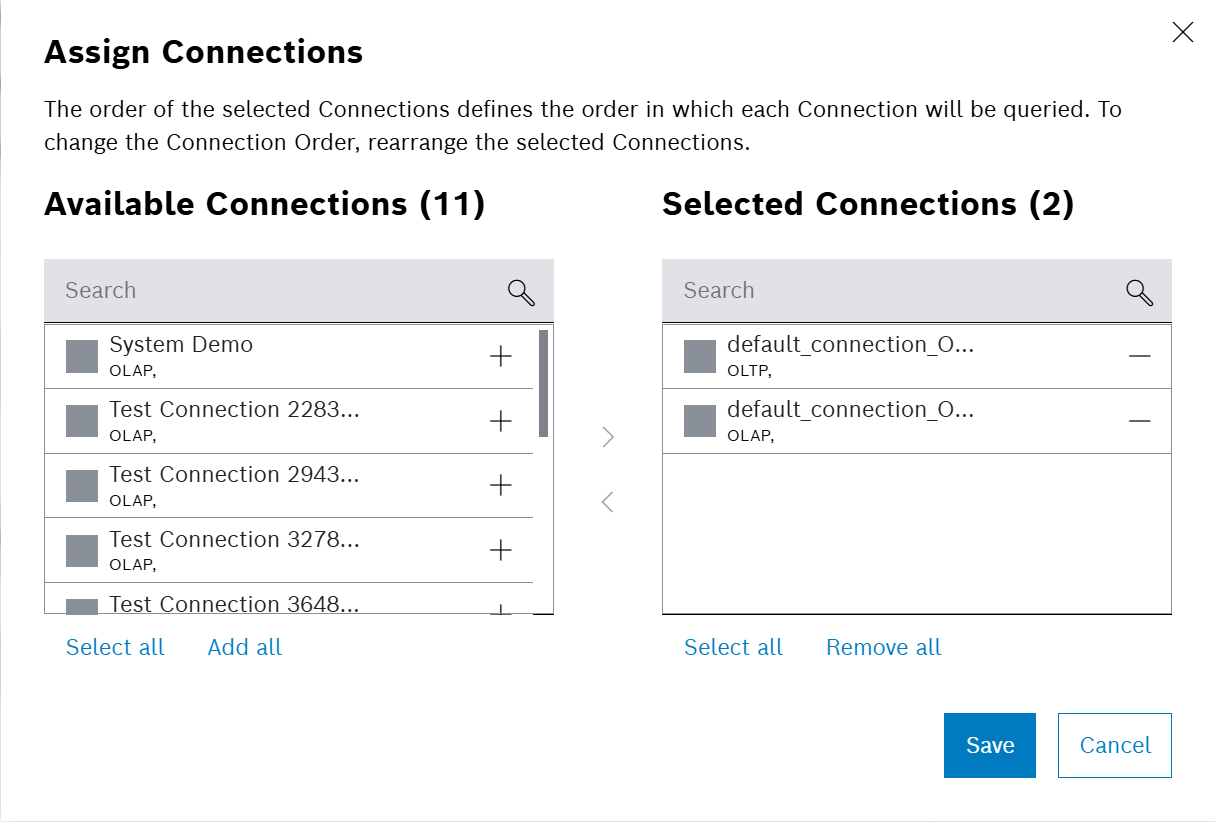
    Assigning Connections
  8. Click on Save.

    A confirmation prompt is shown.

  9. Confirm with Confirm.

    The changes are saved and the connections are linked to the Configuration Scope.
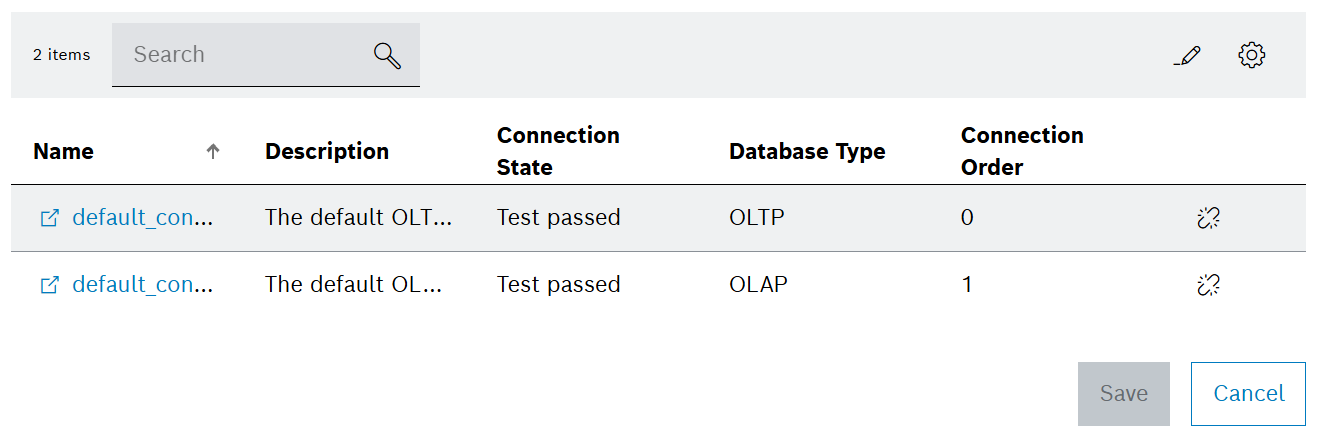
    Assigned Connections

Unlink connections

Unlinking a connection from a Configuration Scope will remove the connection from the Configuration Scope. The connection will still be available in the system and can be linked to another Configuration Scope.

Prerequisites

  • Add Database Connection

  • Add Configuration Scope

  • Assign connections

Procedure

  1. Open Part Traceability > Configuration menu entry.

  2. Click on the Scope Management tab.

  3. Click on the Configuration Scope to be edited.

    A side panel opens. The General tab is shown.

  4. Click on the Connections tab.

    Assigned Connections
  5. Click on link broken.

    A confirmation prompt is shown.

  6. Confirm with Unlink.

The connection is unlinked from the Configuration Scope.

Delete Configuration Scope

Deleting a Configuration Scope will also delete all linked Test Specifications.

Deleting a Configuration Scope will not delete the linked Database Connections. The connection will still be available in the system and can be linked to another Configuration Scope.

Prerequisites

Add Configuration Scope

Procedure

  1. Open Part Traceability > Configuration menu entry.

  2. Click on the Scope Management tab.

  3. Click on delete.

    A configuration prompt is shown.

  4. Confirm with Delete.

    A configuration prompt is shown.

  5. Confirm with Confirm.

    The Configuration Scope is deleted and a success message is shown at the bottom of the screen.

Contents

© Robert Bosch Manufacturing Solutions GmbH 2023-2025, all rights reserved

Changelog Corporate information Legal notice Data protection notice Third party licenses