Edit target values
The following rules apply for entering the targets:
-
The target must always be entered as an absolute value in the corresponding unit (e.g. 70% for OEE or 200 parts per associate per hour for productivity).
-
The lower/upper intervention limit is optional depending on the KPI and must always be entered as a percentage of the target value. If the KPI element is a percentage, the value entered is added or subtracted from the target value. For KPIs with absolute units, the value is calculated as a percentage. See the example below.
Prerequisites
-
Administration: Adminrole -
The Target Values tab opens. Target Values tab
Procedure
-
Select facility. Select equipment
-
Select a KPI element or type group depending on the display mode set. Select KPI element or type group
-
Select time stamp. Select time stamp
The new target values apply from the selected time stamp.
-
To see the desired type groups or KPI elements, deactivate the
 Only with target value filter if necessary.
 -
Select at least one type group or KPI element by activating the checkboxes at the beginning of the relevant rows.
-
Click
 Edit.
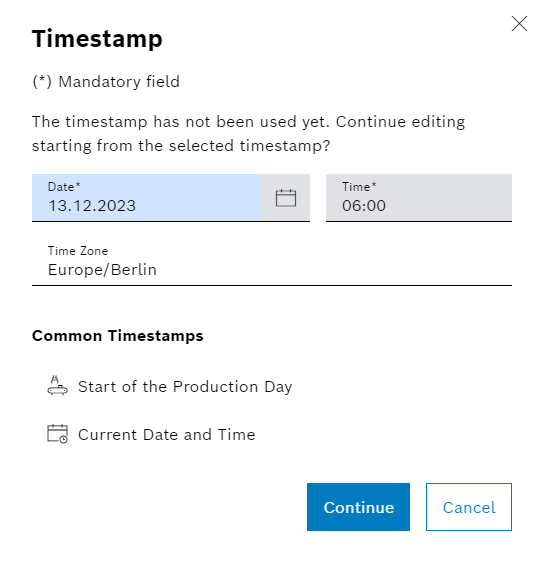
Edit.If the time stamp has not been set yet, the Time stamp dialog opens with a corresponding note.
-
Select the date and time.
-
Click Continue.
The Edit Target Values dialog opens.
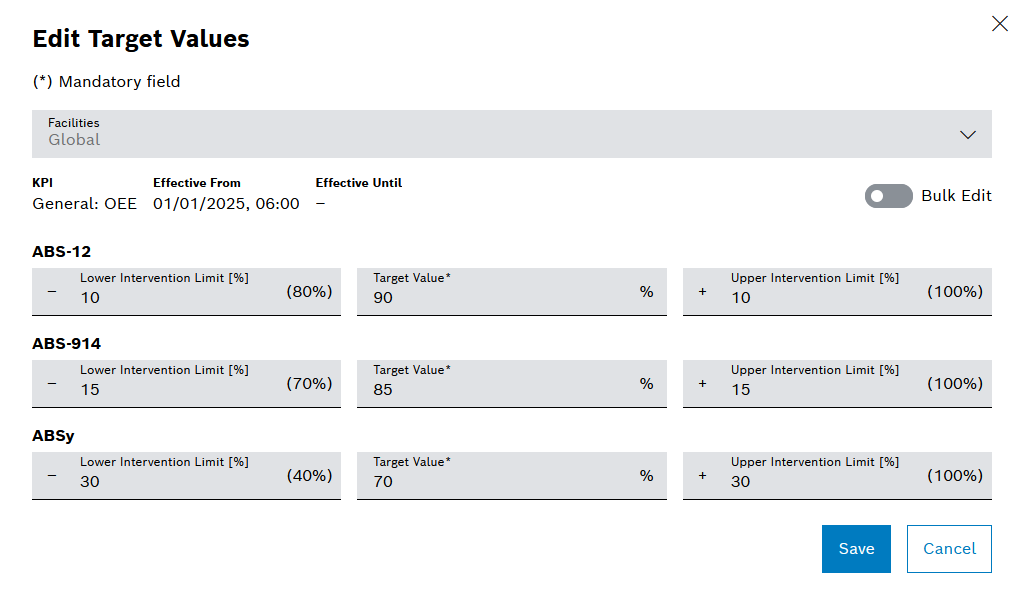
If display mode is set to by KPI and multiple items have been selected, Bulk Edit can be used to edit all target values at once.
-
-
Make changes.
-
Facility , KPI Element , Type Group , Effective From , Effective To
Displays the previously selected conditions.
-
Lower intervention limit (%)
Lower intervention limit. Entered as a percentage of the target. The effective control limit is shown in rounded brackets.
-
Target Value
Set value. The unit depends on which KPI has been selected.
-
Upper intervention limit (%)
Upper intervention limit. Entered as a percentage of the target.
-
-
Click Save.
The target values for the type groups or KPI elements are saved.
|
If targets are set for a date and/or time within a shift, the targets do not apply until the beginning of the next shift. |
|
Targets are in principle valid for an unlimited period from the selected time stamp and can only be overwritten by targets further in the future, but never deleted in sections. |
|
An existing target is automatically extended into the past if a new target differs only in the time stamp, but the target (including upper/lower control limit) itself is the same. |
Example: Target for the KPI productivity
The target value of type group CP1_Typ4 at the CP1H Assembly line should be assigned a target value for the KPI Productivity from 16.02.2022, 13:25. Since a target value does not yet exist, the Only with target value filter must be deactivated to be able to select the type group.
-
Select the CP1H Assembly facility.
-
Select the Productivity KPI element.
-
Select the time stamp 16.02.2022, 13:25. Select time stamp
The new target values apply from the selected time stamp.
-
Deactivate the
Only with target value filter. -
Click
Edit. -
Make changes.
-
Edit target value.
The productivity is intended to be ( Target value ) 20 parts per worker per hour, with the Lower intervention limit 20 % below that. No Upper intervention limit is specified.
This results in an effective value for the Lower intervention limit of 16 parts per worker per hour:image::kpi_example_dialog_edit_target_value.png[kpi_example_dialog_edit_target_value]
Since no other target value has been assigned yet, the values are valid from the selected date 16.02.2022, 13:25 into the future without restriction. -
Click Save.