Nexeed
    • Introduction
    • User manual
      • Getting started
        • Device registration overview
          • Registering a device
          • Self-registration of devices
        • Device claiming
          • Adding a ctrlX Core device
          • Adding a Rexroth connectivity unit device
      • Device overview
        • Setting the filter for the search
        • Device details
        • Edit device properties
        • Roll out artifacts on one or more devices
        • Rolling out a distribution
      • Device groups
        • Creating a device group
      • Machine overview
        • Create, edit and delete machines
        • Adding machines and devices via CSV file import
        • Structure of the CSV import file
      • Activity overview
      • Distribution overview
        • Managing distributions
        • Managing commands in a distribution
    • Operations manual
      • Overview
      • System architecture and interfaces
        • Element descriptions
        • Network connections overview
      • System requirements
        • General system requirements
        • Ingress controller
        • idm/idm-device-administration-app
        • idm/idm-software-management-app
        • idm/idm-device-monitoring-app
        • idm/idm-device-master-data-mgmt-app
        • idm/idm-device-app
        • idm/idm-solution-app
        • idm/idm-webapp-backend
        • idm/idm-device-tunnel-app
        • idm/idm-artifact-repository
        • bci-app/opensearch
        • bci-app/opensearch-dashboards
        • bci-app/valkey
        • bci-app/nginx
        • bci-kube/nexeed-ansible-operator
      • Migration from previous versions
      • Setup and configuration
        • Installation guide
          • How to initialize OpenSearch
          • How to create MACMA tenants with basic authentication
          • How to configure tenants for artifact-related use cases
        • Configuration
          • Detailed configuration parameters
          • Recommendations for service meshes
      • Start and shutdown
      • Regular operations
        • Whitelist new certificate
      • Failure handling
        • Device Portal data is out of sync
        • How to synchronize devices and machines to OpenSearch
        • Synchronize communication id mapping to key-value store (Redis/Valkey)
      • Backup and Restore
      • Logging and monitoring
      • Known limitations
    • Developer guide
      • Communication ID
      • Adding diagnostic functionality to devices
      • Add command processing to devices
      • Add the backup/restore functionality to devices
      • Reducing data consumption of device communication
      • Access through a custom application
    • Artifact Repository guide
      • Introduction
      • Providing artifacts for roll-out
        • Establishing a connection to the Device Portal
        • Uploading and managing artifacts in the repository
      • Downloading artifacts
      • Sending commands
    • API documentation
    • Glossary
Device Portal
  • Industrial Application System
  • Core Services
    • Block Management
    • Deviation Processor
    • ID Builder
    • Multitenant Access Control
    • Notification Service
    • Ticket Management
    • Web Portal
  • Shopfloor Management
    • Andon Live
    • Global Production Overview
    • KPI Reporting
    • Operational Routines
    • Shift Book
    • Shopfloor Management Administration
  • Product & Quality
    • Product Setup Management
    • Part Traceability
    • Process Quality
    • Setup Specs
  • Execution
    • Line Control
    • Material Management
    • Order Management
    • Packaging Control
    • Rework Control
  • Intralogistics
    • AGV Control Center
    • Stock Management
    • Transport Management
  • Machine & Equipment
    • Condition Monitoring
    • Device Portal
    • Maintenance Management
    • Tool Management
  • Enterprise & Shopfloor Integration
    • Archiving Bridge
    • Data Publisher
    • Direct Data Link
    • Engineering UI
    • ERP Connectivity
    • Gateway
    • Information Router
    • Master Data Management
    • Orchestrator

Nexeed Learning Portal

  • Device Portal
  • Artifact Repository guide
  • Providing artifacts for roll-out
  • Establishing a connection to the Device Portal

Establishing a connection to the Device Portal

Requirements

  • Existing Internet connection

  • Login with your Bosch ID

  • Tenant ID

Process

  1. In the browser, call up the following URL with the appropriate Tenant ID: https://deviceportal.bosch.com/?= tenantId

    The Tenant ID is a unique identifier of an organization.

The Device Portal is loaded and the Device Overview view appears.

Requesting a Separate Artifact Repository for the Tenant or Connecting an Existing One

An Artifact Repository must be requested to be able to roll out your own software or configurations to your devices. This Artifact Repository is available either in the form of a Private Artifact Repository or Managed Artifact Repository.

The Private Artifact Repository must be set up and operated in its own Azure subscription, while the Managed Artifact Repository is available as part of the Device Portal solution and only has to be connected to the tenant.

The software, configurations, backups and diagnostic files for the Managed Artifact Repository are stored in the Device Portal solution.

There is a separate additional Rexroth AG software repository for the ctrlX CORE. This solution from Rexroth AG can only be connected directly when creating the tenant and cannot be requested via the Artifact Repository configuration window.

For more information, see the performance specification , the Developer Guide or the Artifact Management Guide.

  1. Log in to the relevant tenant.

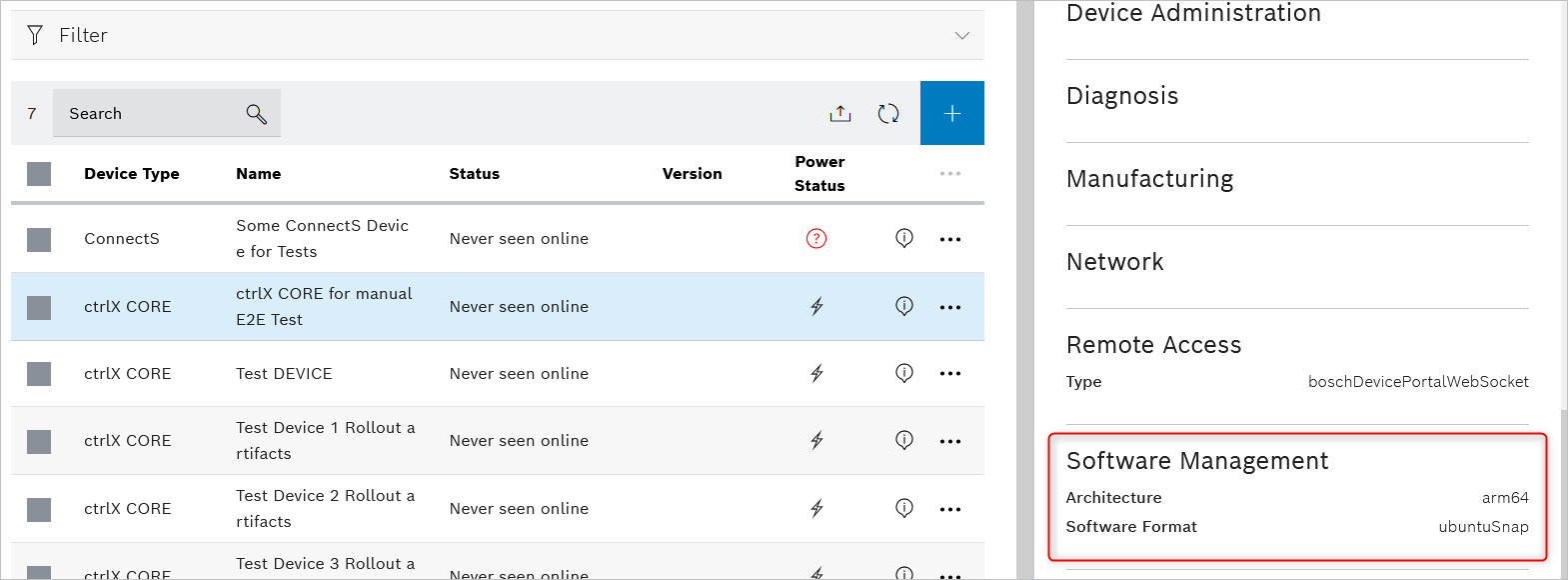
  2. Click on any device in the Device Overview, (e.g. ctrlX CORE) that has the software category Software Management.
    DevicePortal_DeviceOverview_DetailView_Category
  3. Click Configuration settings.

    DevicePortal_SoftwareList_GearWheel

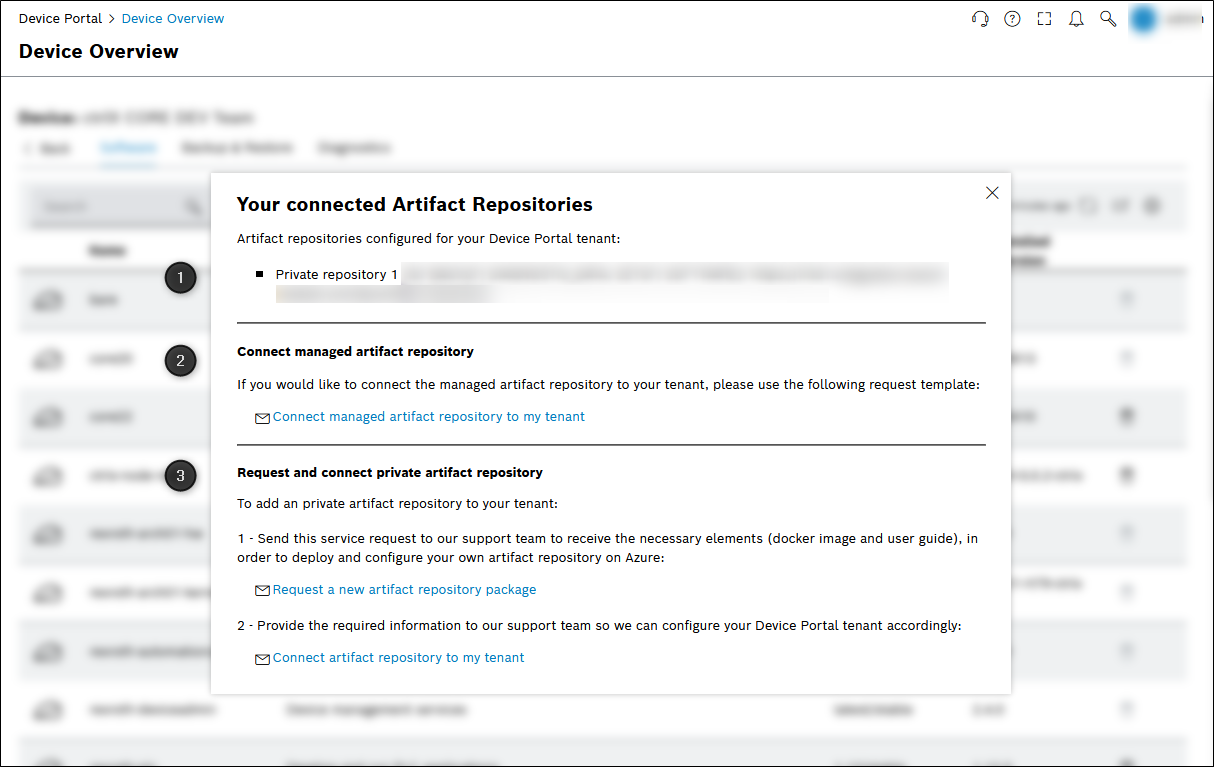
    The Your connected Artifact Repositories dialog opens.
    DevicePortal_ConnectionView
    • (1) Displays all connected Private Artifact Repositories and Managed Artifact Repositories.

    • (2) Request to connect a Managed Artifact Repository if it is not yet connected.

    • (3) Request to create and connect a Private Artifact Repository.

      Up to 3 Private Artifact Repositories can be connected to one tenant.

      The Private Artifact Repository must be operated in a separate Azure subscription to the Managed Artifact Repository.

  4. Click on Connect Managed Artifact Repository (2) to connect a Managed Artifact Repository.

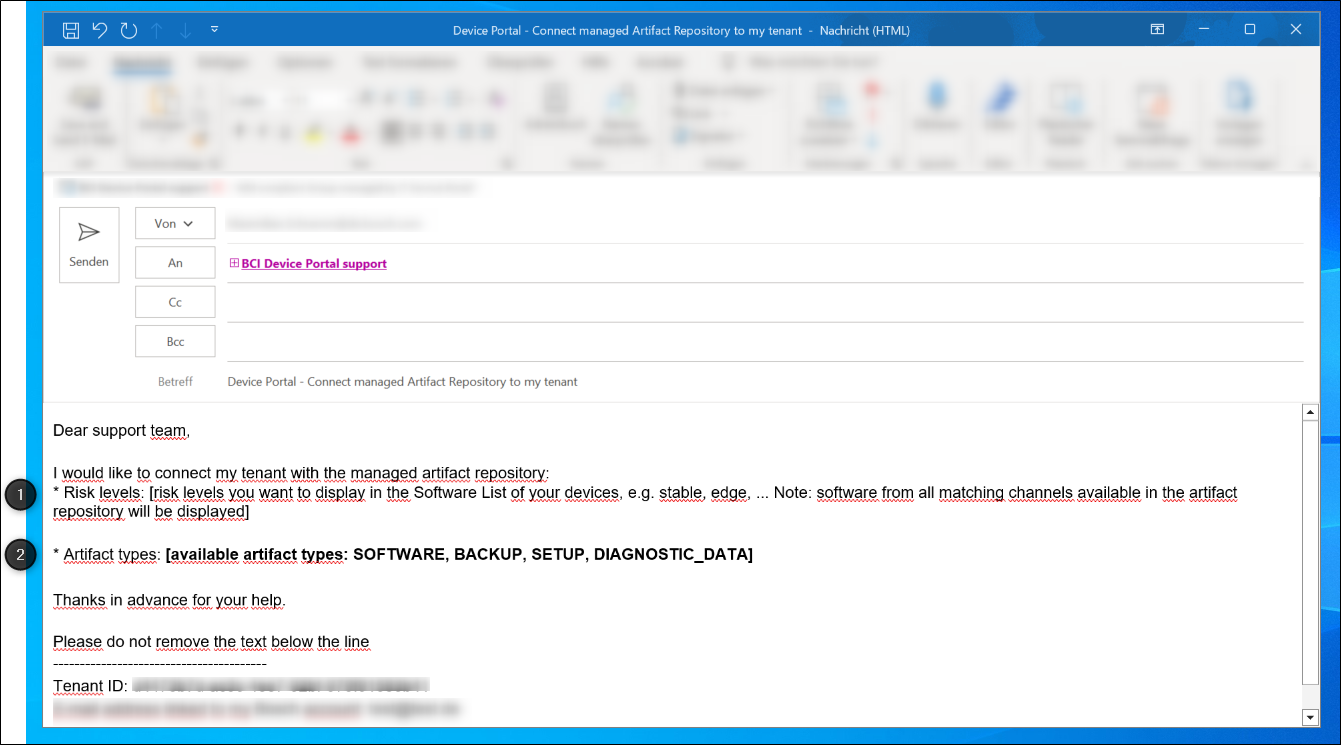
    An email template opens.
    DevicePortal_ConnectManagedArtifactRepository
  5. List in the email under Artifact Types (2) for which functionality the Managed Artifact Repository is to be used.

    The artifact are only visible in the Device Portal if the artifact types have been saved when the Artifact Repository is connected. Therefore, we recommend that you request all artifact types immediately before using them for the first time. Artifacts with the risk level (1) stable, edge, candidate and beta should also be requested.

    The significance of the Artifact Types and Risk Levels is explained in the How to Manage Artifacts guide. This is available to the customer on request.

    • Backup/restore and diagnostics: Enter BACKUP and DIAGNOSTIC_DATA.

    • Software and setup file management: Enter SOFTWARE and SETUP.

  6. After receiving the feedback from Device Portal Support, check whether the requested Artifact Repository is connected correctly:

    • In the Device Overview in the Software tab , check whether the artifacts are marked with a yellow or red icon.

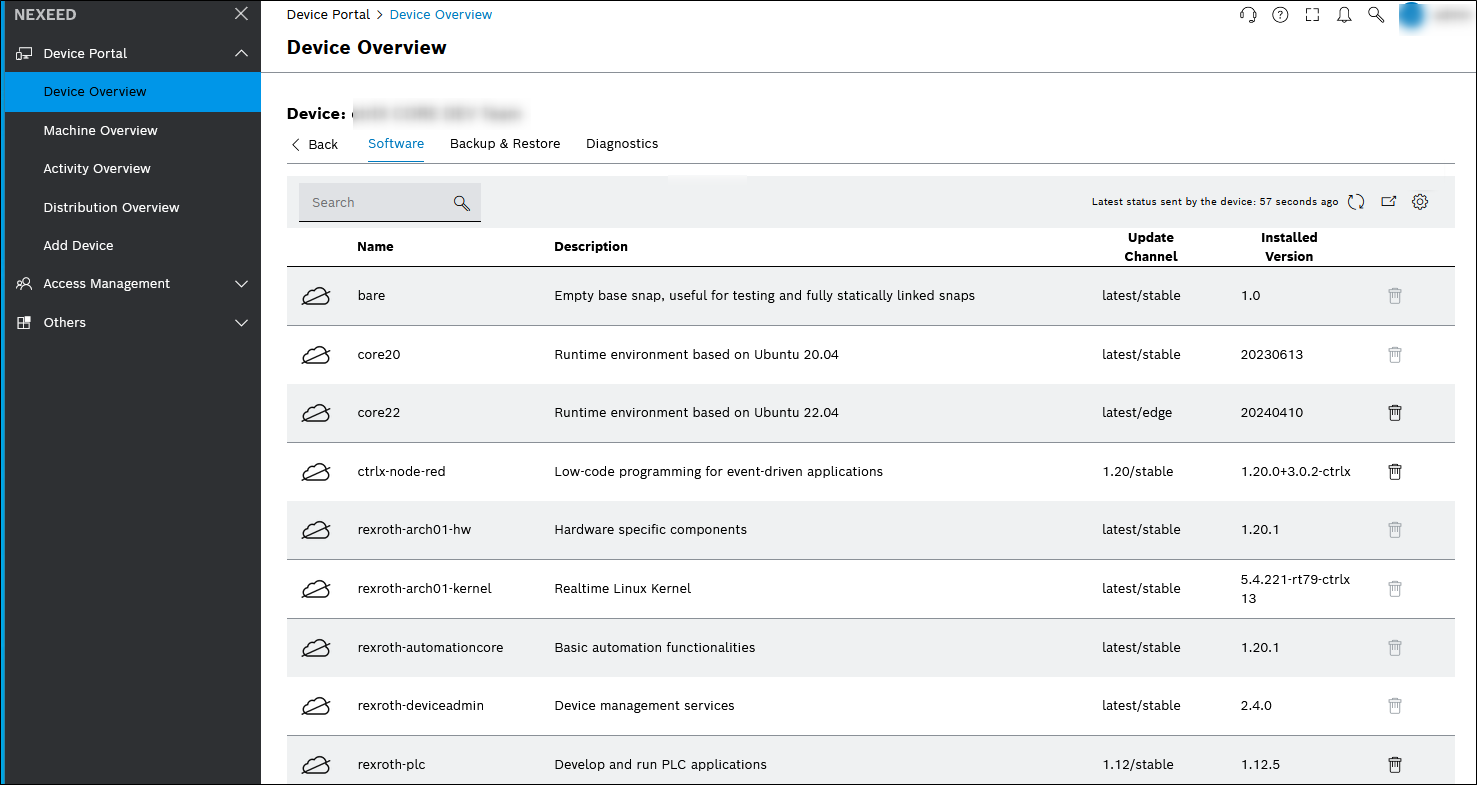
      After connecting a Managed Artifact Repository , the icons are yellow.

      After connecting a Private Artifact Repository , the icons are red.
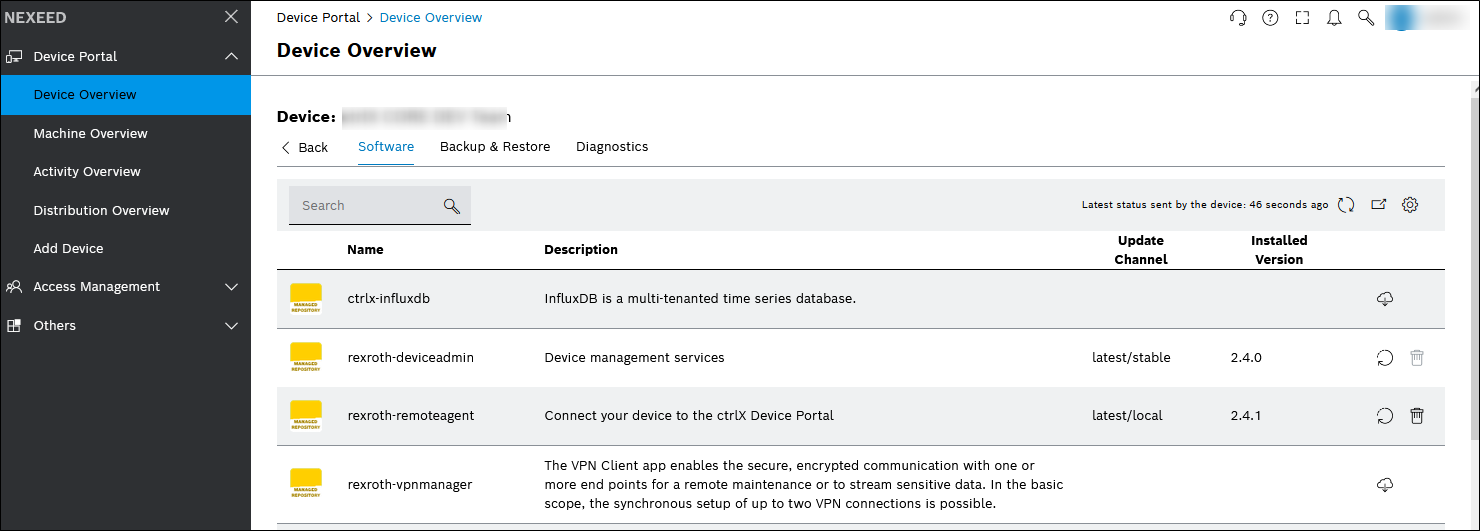
      DevicePortal_SoftwareList_ManagedArtifactRepoOnly
    • If a Rexroth AG Repository is connected for ctrlX CORE , the icons are blue.
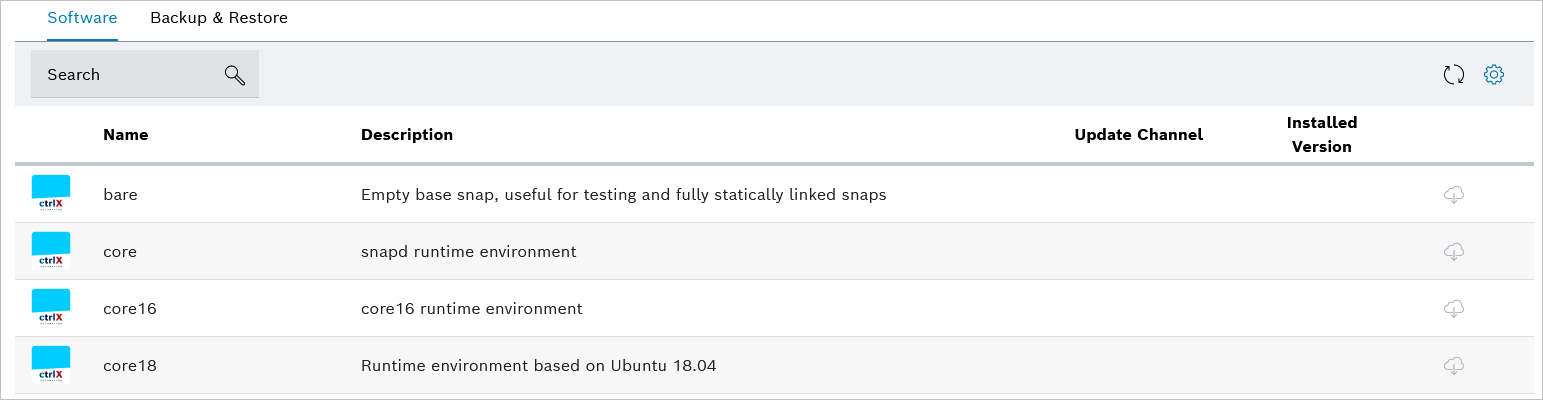
      DevicePortal_SoftwareList
    • Open the configuration again and check in the Your Connected Artifact Repositories dialog whether the Managed Artifact Repository, including the configured artifacts, which are visible in the Device Portal and can be used by the devices, is displayed.

      The screenshot shows backups, diagnostic files, setup files and software. The documentation page of the Artifact Repository is also displayed for the Managed Artifact Repository.
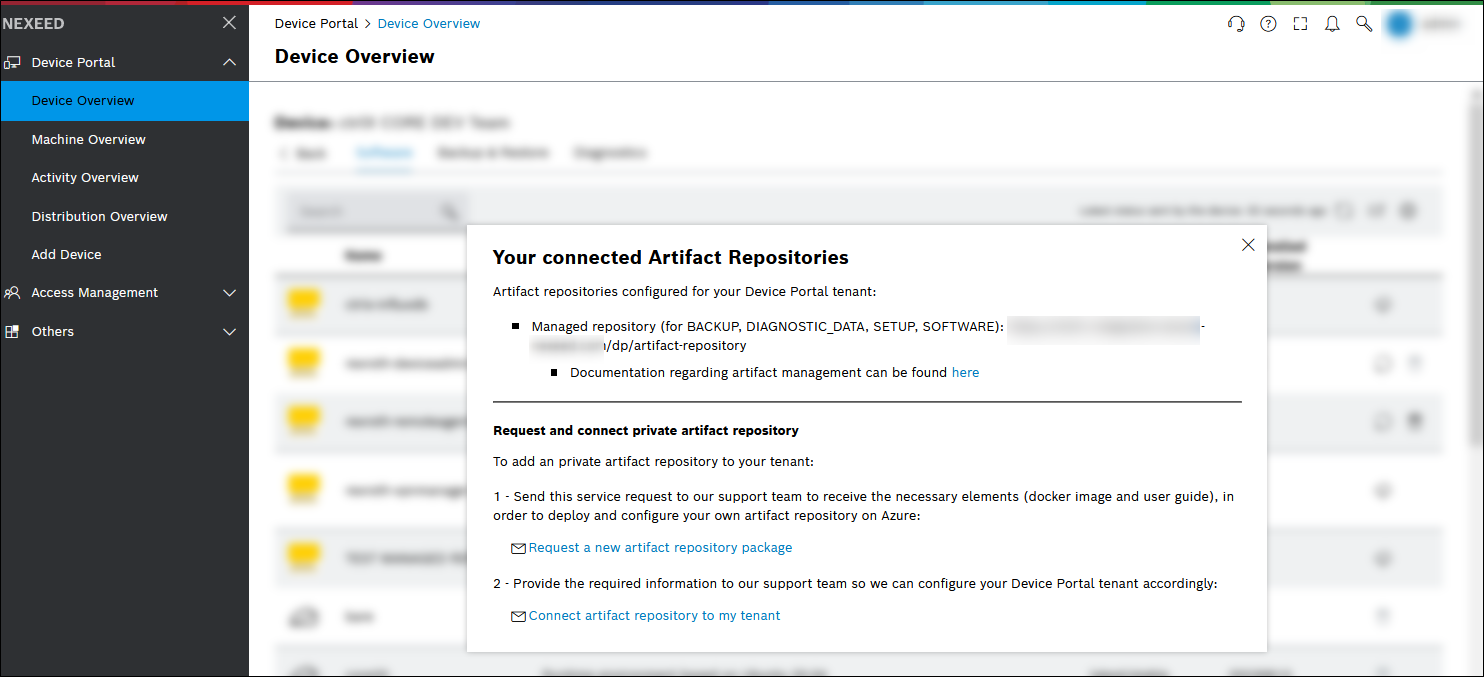
      DevicePortal_ConnectedArtifactRepositoryWithoutManaged

The Private or Managed Artifact Repository is now connected to the tenant. See Deploying Your First Own Software for a description of how artifacts can now be managed in the Artifact Repository

Contents

© Robert Bosch Manufacturing Solutions GmbH 2023-2025, all rights reserved

Changelog Corporate information Legal notice Data protection notice Third party licenses