Nexeed
    • Introduction
    • User manual
      • Getting started
        • Device registration overview
          • Registering a device
          • Self-registration of devices
        • Device claiming
          • Adding a ctrlX Core device
          • Adding a Rexroth connectivity unit device
      • Device overview
        • Setting the filter for the search
        • Device details
        • Edit device properties
        • Roll out artifacts on one or more devices
        • Rolling out a distribution
      • Device groups
        • Creating a device group
      • Machine overview
        • Create, edit and delete machines
        • Adding machines and devices via CSV file import
        • Structure of the CSV import file
      • Activity overview
      • Distribution overview
        • Managing distributions
        • Managing commands in a distribution
    • Operations manual
      • Overview
      • System architecture and interfaces
        • Element descriptions
        • Network connections overview
      • System requirements
        • General system requirements
        • Ingress controller
        • idm/idm-device-administration-app
        • idm/idm-software-management-app
        • idm/idm-device-monitoring-app
        • idm/idm-device-master-data-mgmt-app
        • idm/idm-device-app
        • idm/idm-solution-app
        • idm/idm-webapp-backend
        • idm/idm-device-tunnel-app
        • idm/idm-artifact-repository
        • bci-app/opensearch
        • bci-app/opensearch-dashboards
        • bci-app/valkey
        • bci-app/nginx
        • bci-kube/nexeed-ansible-operator
      • Migration from previous versions
      • Setup and configuration
        • Installation guide
          • How to initialize OpenSearch
          • How to create MACMA tenants with basic authentication
          • How to configure tenants for artifact-related use cases
        • Configuration
          • Detailed configuration parameters
          • Recommendations for service meshes
      • Start and shutdown
      • Regular operations
        • Whitelist new certificate
      • Failure handling
        • Device Portal data is out of sync
        • How to synchronize devices and machines to OpenSearch
        • Synchronize communication id mapping to key-value store (Redis/Valkey)
      • Backup and Restore
      • Logging and monitoring
      • Known limitations
    • Developer guide
      • Communication ID
      • Adding diagnostic functionality to devices
      • Add command processing to devices
      • Add the backup/restore functionality to devices
      • Reducing data consumption of device communication
      • Access through a custom application
    • Artifact Repository guide
      • Introduction
      • Providing artifacts for roll-out
        • Establishing a connection to the Device Portal
        • Uploading and managing artifacts in the repository
      • Downloading artifacts
      • Sending commands
    • API documentation
    • Glossary
Device Portal
  • Industrial Application System
  • Core Services
    • Block Management
    • Deviation Processor
    • ID Builder
    • Multitenant Access Control
    • Notification Service
    • Ticket Management
    • Web Portal
  • Shopfloor Management
    • Andon Live
    • Global Production Overview
    • KPI Reporting
    • Operational Routines
    • Shift Book
    • Shopfloor Management Administration
  • Product & Quality
    • Product Setup Management
    • Part Traceability
    • Process Quality
    • Setup Specs
  • Execution
    • Line Control
    • Material Management
    • Order Management
    • Packaging Control
    • Rework Control
  • Intralogistics
    • AGV Control Center
    • Stock Management
    • Transport Management
  • Machine & Equipment
    • Condition Monitoring
    • Device Portal
    • Maintenance Management
    • Tool Management
  • Enterprise & Shopfloor Integration
    • Archiving Bridge
    • Data Publisher
    • Direct Data Link
    • Engineering UI
    • ERP Connectivity
    • Gateway
    • Information Router
    • Master Data Management
    • Orchestrator

Nexeed Learning Portal

  • Device Portal
  • User manual
  • Device groups
  • Creating a device group

Creating a device group

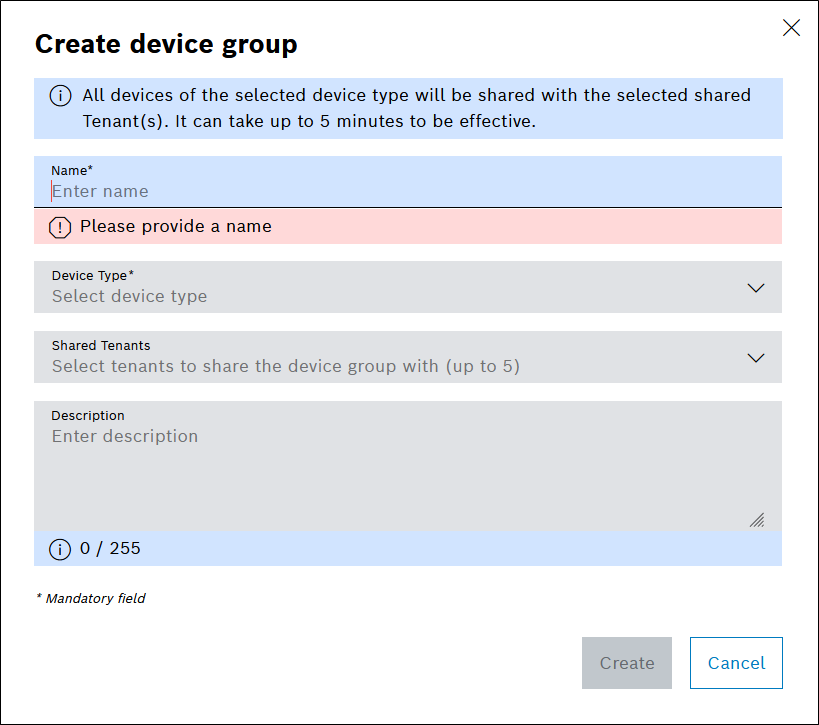
When a device group is created, the relevant devices must be defined and assigned to it. It is also necessary to specify the contract partner with whom the devices are to be shared.

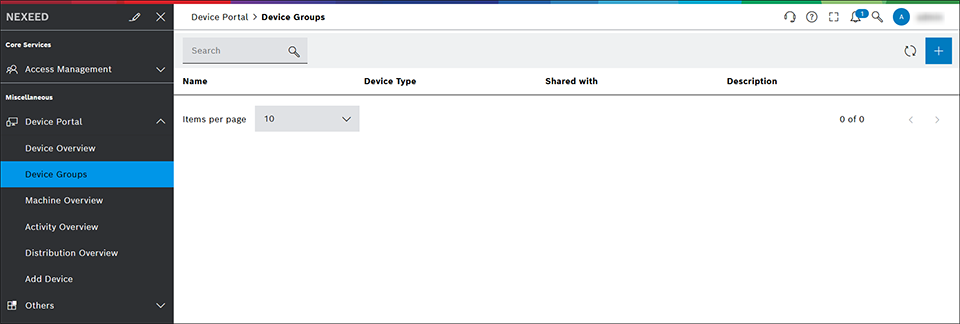
  1. Open the Device Group Overview and create a new group.
    241029
    241025

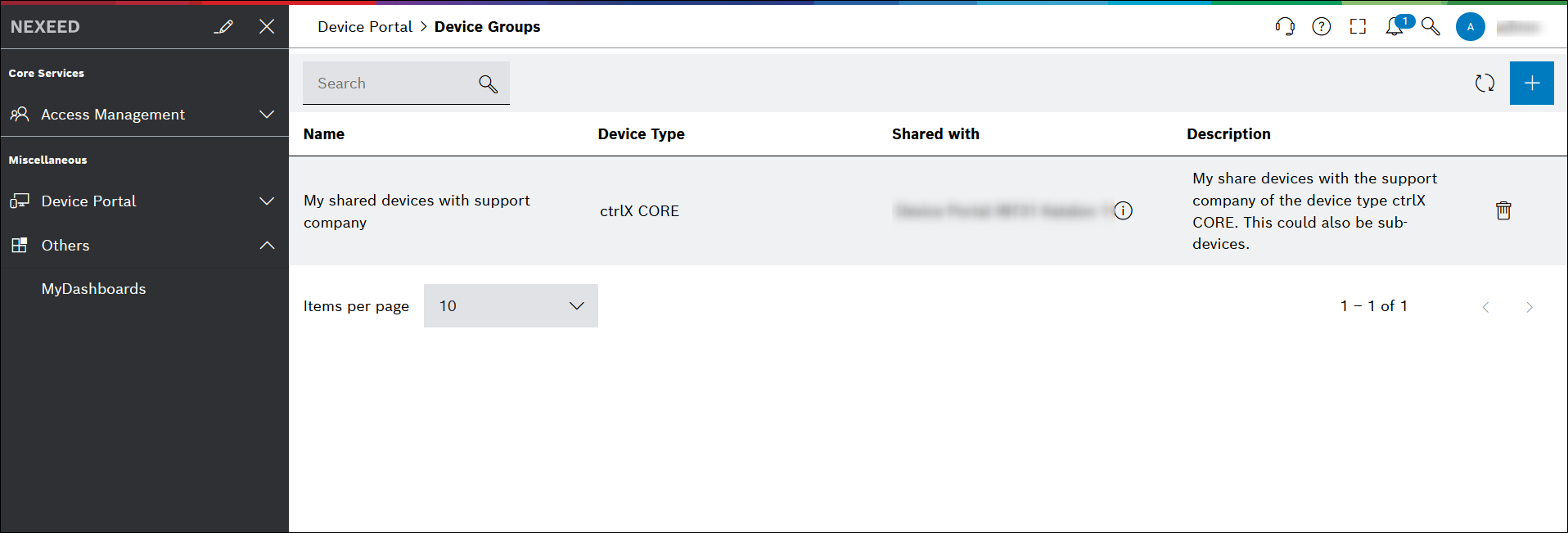
    Only tenants with which a digital contract for the organization of Access Management has been concluded can be selected under Shared Tenants. Further information can be found in the Access Management manual.

    If a device group is deleted, sharing with the selected tenants is terminated. The Device type field displays all device types that are used in the current tenant, provided that at least one device is present. Currently, the selected tenants have full access to the respective devices, so the permissions for the devices cannot be restricted further.

The device group and all the devices assigned to it are shared with the selected target tenants. This may take a few minutes.
241028

Contents

© Robert Bosch Manufacturing Solutions GmbH 2023-2025, all rights reserved

Changelog Corporate information Legal notice Data protection notice Third party licenses