Nexeed
    • Introduction
    • User manual
      • Getting started
        • Device registration overview
          • Registering a device
          • Self-registration of devices
        • Device claiming
          • Adding a ctrlX Core device
          • Adding a Rexroth connectivity unit device
      • Device overview
        • Setting the filter for the search
        • Device details
        • Edit device properties
        • Roll out artifacts on one or more devices
        • Rolling out a distribution
      • Device groups
        • Creating a device group
      • Machine overview
        • Create, edit and delete machines
        • Adding machines and devices via CSV file import
        • Structure of the CSV import file
      • Activity overview
      • Distribution overview
        • Managing distributions
        • Managing commands in a distribution
    • Operations manual
      • Overview
      • System architecture and interfaces
        • Element descriptions
        • Network connections overview
      • System requirements
        • General system requirements
        • Ingress controller
        • idm/idm-device-administration-app
        • idm/idm-software-management-app
        • idm/idm-device-monitoring-app
        • idm/idm-device-master-data-mgmt-app
        • idm/idm-device-app
        • idm/idm-solution-app
        • idm/idm-webapp-backend
        • idm/idm-device-tunnel-app
        • idm/idm-artifact-repository
        • bci-app/opensearch
        • bci-app/opensearch-dashboards
        • bci-app/valkey
        • bci-app/nginx
        • bci-kube/nexeed-ansible-operator
      • Migration from previous versions
      • Setup and configuration
        • Installation guide
          • How to initialize OpenSearch
          • How to create MACMA tenants with basic authentication
          • How to configure tenants for artifact-related use cases
        • Configuration
          • Detailed configuration parameters
          • Recommendations for service meshes
      • Start and shutdown
      • Regular operations
        • Whitelist new certificate
      • Failure handling
        • Device Portal data is out of sync
        • How to synchronize devices and machines to OpenSearch
        • Synchronize communication id mapping to key-value store (Redis/Valkey)
      • Backup and Restore
      • Logging and monitoring
      • Known limitations
    • Developer guide
      • Communication ID
      • Adding diagnostic functionality to devices
      • Add command processing to devices
      • Add the backup/restore functionality to devices
      • Reducing data consumption of device communication
      • Access through a custom application
    • Artifact Repository guide
      • Introduction
      • Providing artifacts for roll-out
        • Establishing a connection to the Device Portal
        • Uploading and managing artifacts in the repository
      • Downloading artifacts
      • Sending commands
    • API documentation
    • Glossary
Device Portal
  • Industrial Application System
  • Core Services
    • Block Management
    • Deviation Processor
    • ID Builder
    • Multitenant Access Control
    • Notification Service
    • Ticket Management
    • Web Portal
  • Shopfloor Management
    • Andon Live
    • Global Production Overview
    • KPI Reporting
    • Operational Routines
    • Shift Book
    • Shopfloor Management Administration
  • Product & Quality
    • Product Setup Management
    • Part Traceability
    • Process Quality
    • Setup Specs
  • Execution
    • Line Control
    • Material Management
    • Order Management
    • Packaging Control
    • Rework Control
  • Intralogistics
    • AGV Control Center
    • Stock Management
    • Transport Management
  • Machine & Equipment
    • Condition Monitoring
    • Device Portal
    • Maintenance Management
    • Tool Management
  • Enterprise & Shopfloor Integration
    • Archiving Bridge
    • Data Publisher
    • Direct Data Link
    • Engineering UI
    • ERP Connectivity
    • Gateway
    • Information Router
    • Master Data Management
    • Orchestrator

Nexeed Learning Portal

  • Device Portal
  • User manual
  • Device overview
  • Device details

Device details

The view can be called up by clicking on the respective device.

Depending on the device type, backups of the device software can also be created, which can also be used to restore the device software in the Device Portal.

The Software and Backup & Restore tabs are visible depending on the device type.

Software tab

The software of the device can be managed here: Newly provided software from a connected Artifact Repository can be installed; existing software can be updated or deleted.

235983
No. Description

1

List of software that is on the selected device.

2

Search

3

Refresh the list.

4

Related links

5

Artifact Repository

6

Install software There is new software that can be installed on the device.

7

Update software There is a new version of installed software that can be updated on the device.

8

Uninstall the software

Backup & Restore tab

Under the Backup & Restore tab, backups can be made for each device. The devices can be restored using the created backups if necessary.

235988
No. Description

1

List of available backups

2

Search

3

Perform a new backup for the selected device

4

Options menu for backup:

  • Delete : Delete the backup

  • Restore device to this state : Restore the device with the selected backup.

  • Restore to other device : Restore devices (up to 10) of the same type with the selected backup.

Diagnostics tab

The device’s diagnostic data can be managed here: To do this, the desired diagnostic data can be uploaded from the device to the Device Portal Upload diagnostic data of a device and then saved locally Download diagnostic data of a device.
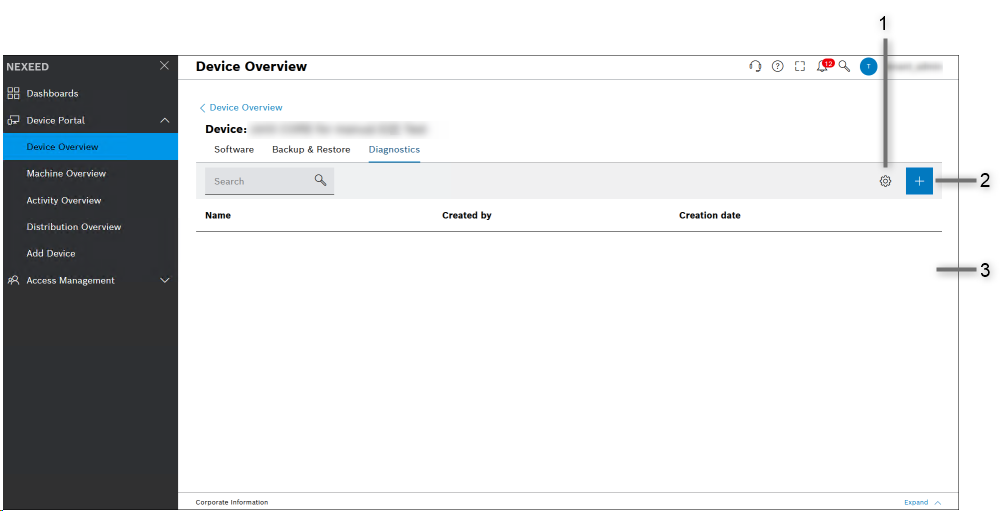
236163
No. Description

1

Artifact Repository

2

Upload new diagnostic data of the device

3

List with max. 10 diagnostic data per device

Uploading diagnostic data of a device

Diagnostic data can be used to upload diagnostic information from the device to the Device Portal. The user can then download it again through the UI in order to analyze it locally.

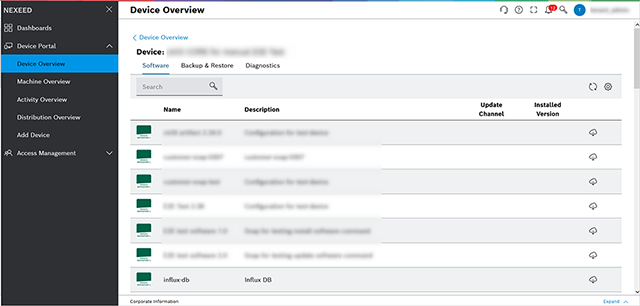
  1. Click on a device in the Device Overview to open the software overview for the device
    233210
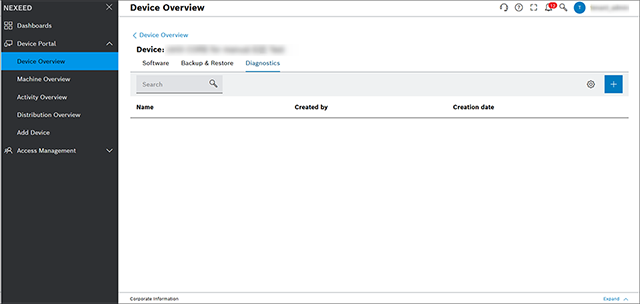
  2. Click on the Diagnostics tab to open the overview page for the diagnostic files.
    233211
  3. Click Add add_border above the Diagnostics table to start a new upload of diagnostic data.

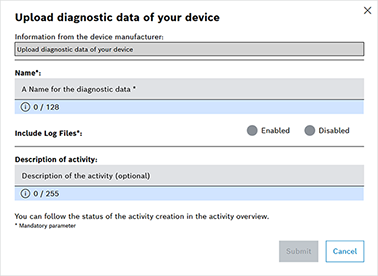
  4. Enter a name and an optional description in the Upload Diagnostic Data of Device window.
    233212
    • Name: Enter a name for the new diagnostic data to be generated.

    • Include Log Files: Enter the individual parameters of the device type for generating the diagnostic file. These may differ for each device type.

    • Description of Activity: Enter the reason for the upload. This will be displayed later in the Activity Overview.

  5. Click Submit to initiate the upload of the diagnostic data to the Device Portal.

The request for uploading the diagnostic data is retrieved from the appropriate device and confirmed by this device. Once this has been done, the device sends the diagnostic data to the Artifact Repository, which then displays it in the table of the Diagnostics tab.

Downloading diagnostic data of a device

Diagnostic data previously uploaded to the device can be downloaded from the Device Portal and saved locally. The number of available diagnostic data of a device is limited to 10.

234861
  1. Click Download 234862 on the right side of the table to download the desired diagnostic data.

    • Click Delete 234863 on the right side of the table to delete the desired diagnostic data.

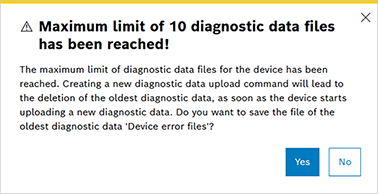
      If the maximum number of diagnostic data for a device has been reached, the following dialog opens.
      234864
    • Clicking on Yes automatically saves the oldest diagnostic data locally and opens the dialog for uploading diagnostic data. As soon as new data has been created here, the oldest diagnostic data is deleted.

    • Clicking No results in the oldest diagnostic data not being saved automatically and opens the dialog for uploading diagnostic data. As soon as new data has been created here, the oldest diagnostic data is deleted.

    • Clicking on X cancels the entire process and closes the dialog.

The downloaded diagnostic data is now available locally in the Downloads folder for further processing.

Contents

© Robert Bosch Manufacturing Solutions GmbH 2023-2025, all rights reserved

Changelog Corporate information Legal notice Data protection notice Third party licenses