Nexeed
    • Introduction
    • User manual
      • Condition monitoring and its tabs
        • Live
        • Counters
        • Measurements
        • Events
        • Rules
        • View configuration
        • Details
      • Rules management
        • Rule types and standard functions
        • Rule details
      • Function configuration
      • Condition Monitoring widgets
      • Access Management
        • Application Roles
        • Fine-Grained Access Control and Configuration
        • How to Configure Organization Roles
    • Operations manual
      • Overview
      • System architecture and interfaces
        • System components
      • System requirements
        • General notes
        • cm/condition-monitoring-core
        • cm/rule-service-app
        • cm/rule-function-executor
        • cm/rule-result-aggregator
        • cm/rule-value-aggregator
        • cm/rule-value-provider
        • cm/stateful-function-executor
      • Migration from previous versions
        • Migration to 2.1+
        • Migration from CPM 1.5.4 to CM and RM 3.0.x (Nexeed IAS 2023.02.00.xx)
          • CPM to CM relational database migration
          • CPM to RM relational database migration
          • CM Influx database migration
          • Deletion of an old CPM installation
        • Resources mapping from MES to IAS Condition Monitoring
        • Migration to 4.0.0+ (Nexeed IAS 2024.01.00.xx)
        • Migration to 4.3.x (Nexeed IAS 2024.02.01.x)
        • Migration to 4.5.x (Nexeed IAS 2025.01.00.x)
        • Migration to 4.6.x (Nexeed IAS 2025.01.01.x)
        • Migration to 4.8.x (Nexeed IAS 2025.02.00.x)
        • Migration to 4.9.x (Nexeed IAS 2025.02.01.x)
        • Migration to 4.10.x (Nexeed IAS 2025.02.02.x)
        • Migration to 4.11.x (Nexeed IAS 2026.01.x)
      • Setup and configuration
        • Manual MACMA configuration after setting up a new tenant
        • RabbitMQ
        • Influx configuration
        • Kafka topics
        • Condition Monitoring - Helm Configuration
        • Advanced configuration parameters
          • cm/condition-monitoring-core
            • Common shared variables
            • Portal shared variables
            • MDM shared variables
            • RabbitMQ shared variables
            • OTEL shared variables
            • Graceful shutdown shared variables
          • cm/rule-service-app
            • Rules Management shared variables
            • KAFKA shared variables
          • cm/rule-function-executor
          • cm/rule-result-aggregator
          • cm/rule-value-aggregator
          • cm/rule-value-provider
          • cm/stateful-function-executor
        • Fine-Grained Access Configuration
      • Start and shutdown
      • Regular operations
      • Failure handling
        • Rule Management Light Helm installation failing when Kafka is disabled or Kafka is not configured at all
        • User manual injection into Rule Management
        • Infrastructure outages: health verification Endpoints
        • OPP/PPMP are not received in CM
        • Master data (Devices, Facilities, Measuring Points, DeviceTypes) is missing in CM
        • Condition Monitoring Domain is missing in Ticket Management
        • CM is not visible in the portal
        • How to verify if the broker is out of sync
      • Backup and Restore
      • Logging and monitoring
        • General logging characteristics
        • Required monitoring
        • General logging format
        • Request-based logging format
        • Security logging format
        • Lifecycle logging format
        • Module health Endpoints and K8s probes
      • Known limitations
    • API documentation
      • Condition Monitoring HTTP API
      • Rules Management HTTP API
    • Glossary
Condition Monitoring
  • Industrial Application System
  • Core Services
    • Block Management
    • Deviation Processor
    • ID Builder
    • Multitenant Access Control
    • Notification Service
    • Ticket Management
    • Web Portal
  • Shopfloor Management
    • Andon Live
    • Global Production Overview
    • KPI Reporting
    • Operational Routines
    • Shift Book
    • Shopfloor Management Administration
  • Product & Quality
    • Product Setup Management
    • Part Traceability
    • Process Quality
    • Setup Specs
  • Execution
    • Line Control
    • Material Management
    • Order Management
    • Packaging Control
    • Rework Control
  • Intralogistics
    • Stock Management
    • Transport Management
  • Machine & Equipment
    • Condition Monitoring
    • Device Portal
    • Maintenance Management
    • Tool Management
  • Enterprise & Shopfloor Integration
    • Archiving Bridge
    • Data Publisher
    • Engineering UI
    • ERP Connectivity
    • Gateway
    • Information Router
    • Master Data Management
    • Orchestrator

Nexeed Learning Portal

  • Condition Monitoring
  • User manual
  • Condition monitoring and its tabs
  • Measurements
preview 4.11.1 4.11.0

Measurements

This device specific view, visualize detailed historic machine data, such as measured values, events, counters and limit values. These data are visualized in a customizable chart, with defined time period and aggregation level.
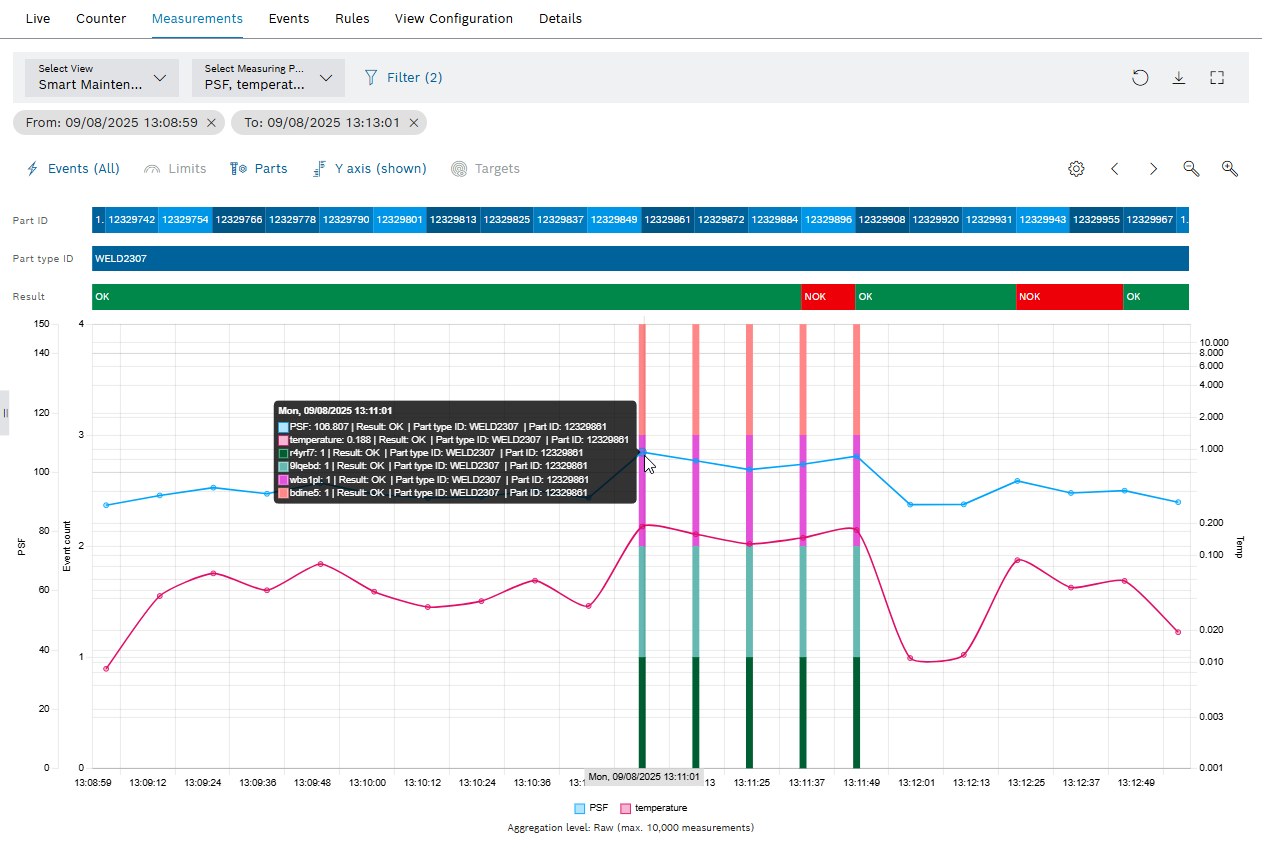
cm_measurements_tab_overview_2023_02
Element Description

Select view

Select a view from the drop-down list.

Searchable drop-down list to select one of the views created from the View Configuration tab.
View configuration tab

All measuring points

This is the default view to display all measuring points of the device.

Select Measuring Point

Search and select the measuring points to be visualized in the chart.

The drop-down list displays all created measurement points for the device. In default all measuring points are selected. Its only possible to show 10 measuring points at one time.
Measuring points

filter Filter

Filter the chart by Time Range or limit displayed Events by Event Code. The selected time range stays also on switching to Events or Rules tab. Filters are persisted in the URL of the browser. This allows the user to share the current view with others.

filter Reset filter

Reset all filters to defaults.

download

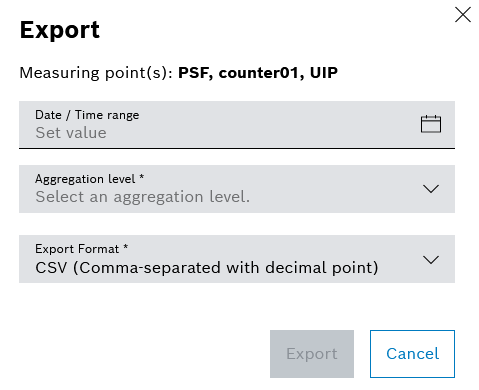
Export measurements as CSV format, by selecting time range, and aggregation level. Export Measuring Points

fullscreen

Open full-screen mode.

The full-screen mode can be closed with [ESC].

flash Events

Show and hide events. By clicking multiple times, it displays all events, only the events of the selected measuring point or no events at all.

speedometer Limit values

Show and hide limit values from the measured value messages.

Limit values are only available with the setting Aggregation level — Raw data (max. 10,000 measured values). The setting can be selected in the aggregation settings.
Configure aggregation settings.

spare-parts Parts

Show and hide the Part ID , Part type ID and Result of the produced part on this device.

chart-topflop-random-vertical Y-axes

Show and hide Y axes.

ppm_target_view Targets

Show and hide setpoint.

Limit values are only available for one selected measuring points and only with the setting Aggregation level — Raw data (max. 10,000 measured values). The setting can be selected in the aggregation settings.
Configure aggregation settings.

settings Aggregation Settings

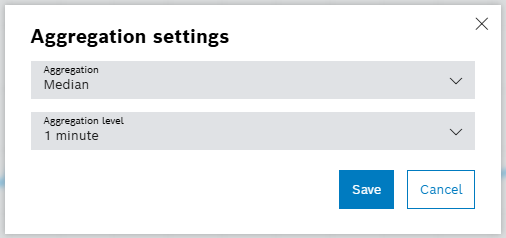
Configure Aggregation Settings of the View. Select Aggregation type and Aggregation Level. Configure aggregation settings

back-left forward-right Time Slider

Navigate forward or back the selected time range.

zoom_out zoom-in Zoom

Zoom in and out. This will select a smaller time window to be displayed in the chart.

This is also possible by draw a rectangle with the mouse into the chart area.

Export Measuring Points

Measuring points can be exported for external analysis.

Prerequisite

Condition Monitoring User or Condition Monitoring Administrator role

Procedure

  1. Call up the Performance analysis > Condition monitoring menu.

  2. Select device.

  3. Open the Measured Values tab.

    The measuring points that are activated in the Select Measuring Point drop-down list are exported.

  4. Activate measuring points from the Select Measuring Point drop-down list.

  5. Open the export settings with download.

    cm_export_measurments_points_2023_02

    If a Date or Time Period is set in the filters of the Measured Values tab, the Date or Time Period is automatically entered in the Date/Time Period field.

  6. Set the Date/Time Period.

  7. Select the Aggregation level.

    Limit values are only available in the Aggregation Level — Raw Data (Max. 10,000 Measured Values). Raw data is only displayed up to six hours in the past. If the maximum of 10,000 displayed measured values is reached, a warning message is issued. All other values are not included in the export.

  8. Select Export Format.

  9. Export measuring points with Export.

  10. Select the directory, enter the file name and confirm with Save.

The measuring points are exported.

Configure aggregation settings

The aggregation settings are additional setting options in the Measured Values tab for identifying errors in the device. For example, outliers in the measured values can be displayed by means of the aggregation settings. The displayed time period can be limited by the filter function in the tab.

Limit values are only available in the Aggregation level — Raw data (max. 10,000 measured values). Raw data is only displayed up to six hours in the past. If the maximum of 10,000 displayed measured values is reached, a warning message is issued.

Prerequisite

Condition Monitoring User or Condition Monitoring Administrator role

Procedure

  1. Call up the Performance analysis > Condition monitoring menu.

  2. Select device.

  3. In the detailed view, open the Measured Values tab.

  4. Select the time period using the filters with filter.

  5. Open the Aggregation settings with settings.

    Aggregationseinstellungen
  6. Select Aggregation.

    Multiple aggregations can be selected to compare.

    • Count

      Display all measured values in the specified time period.

    • Max

      Display the largest measured values in the specified time period.

    • Mean

      Display the average measured values in the specified time period.

    • Median

      Display the median measured values in the specified time period.

    • Min

      Display the smallest measured values in the specified time period.

  7. Select the Aggregation level.

    • Automatic (one minute)

      Display one measurement per minute in the specified time period.

    • Raw data (max. 10,000 measurement values)

      Display raw data from the device within the specified time period.

    • Decimated Raw Data (Max. 10,000 Measurement Values)

      Display only every second measurement of the raw data of the device in the specified time period.

    • One minute

      Display one measurement per minute in the specified time period.

    • 30 minutes

      Display one measurement per 30 minutes in the specified time period.

    • 1 hour

      Display one measurement per hour in the specified time period.

    • 12 hours

      Display one measurement per 12 hours in the specified time period.

    • 1 day

      Display one measurement per 24 hours in the specified time period.

    • 1 month

      Display one measurement per 30 days in the specified time period.

  8. Apply aggregation settings with Save.

The aggregation settings are applied to the Measured Values tab.

Contents

© Robert Bosch Manufacturing Solutions GmbH 2023-2025, all rights reserved

Changelog Corporate information Legal notice Data protection notice Third party licenses