Diese Seite ist nur auf Englisch verfügbar.
Deviation process
The Deviation Processor orchestrates the handling of deviations on the shop floor. The lifecycle of a deviation through the system can be modeled as follows:
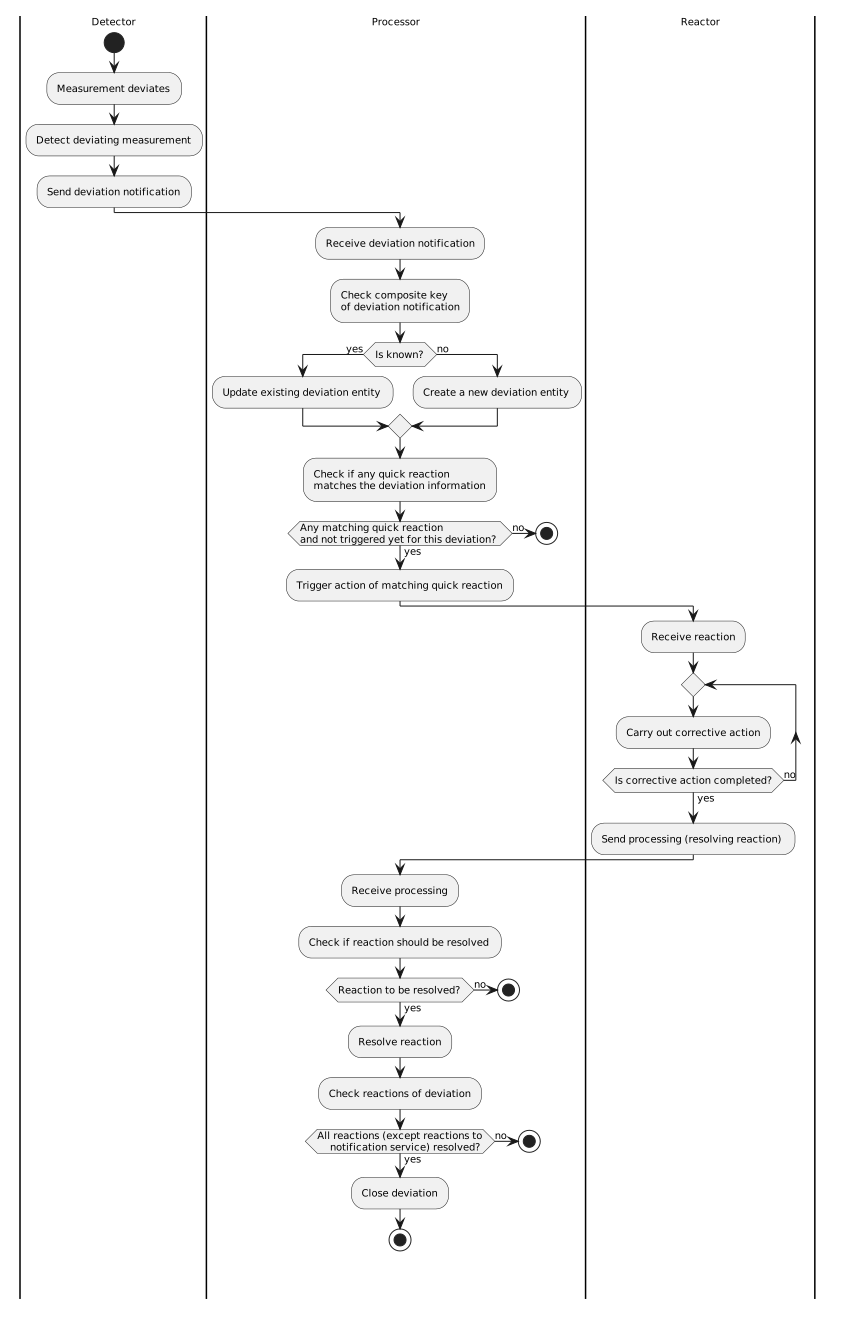
The process consists of four main sections:
-
Detection of Deviations:
-
Deviations are detected by detector modules and reported to the Deviation Processor.
-
Reporting occurs through a standardized interface via a deviation notification.
-
-
Storing and Reacting to Deviations:
-
Information from multiple deviation notifications with the same composite key—potentially from different detectors—is aggregated and stored as deviations in the central database of the Deviation Processor.
-
Reactions to these deviations can be triggered either manually through the user interface or automatically via Quick Reactions.
-
These reactions initiate necessary corrective actions to address underlying issues, such as dispatching a maintenance technician to replace defective parts.
-
Each matching Quick Reaction is only triggered once per deviation.
-
-
Resolving Deviations:
-
Corrective actions are implemented to address the root causes of the deviation.
-
Once the corrective action is successfully completed, reactors resolve the reaction through a processing request.
-
-
Closing a Deviation:
-
If all triggered reactions are resolved, the deviation is automatically closed.
-